
FUE vs FUT Hair Transplant: Difference, Cost, Recovery & Results Guide
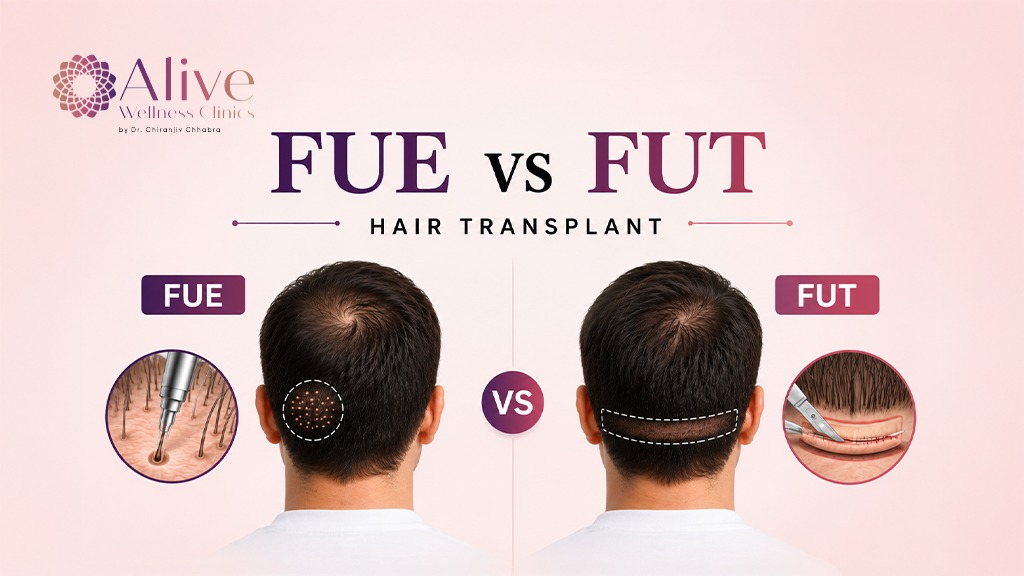
If you're considering a hair transplant, one of the most important decisions you'll make is choosing the right technique: FUE or FUT. Both procedures are clinically proven and widely performed, but they differ in terms of graft extraction, recovery time, scarring, cost, and overall suitability for different stages of hair loss.
Selecting the right approach goes beyond understanding the procedure itself. Factors such as the extent of hair loss, donor hair quality, lifestyle, aesthetic expectations, and long-term goals all play a role in determining the most suitable treatment plan. At Alive Wellness Clinics, every hair restoration journey begins with a personalized assessment to help patients make informed decisions based on their individual needs.
In this guide, we'll compare FUE and FUT hair transplants, including how each procedure works, their advantages and limitations, expected recovery, costs, and long-term results, helping you understand which technique may be best suited for your hair restoration goals.
Also Read: Looking for the hair transplant clinic in Delhi? Discover the key factors to consider before choosing the right clinic for safe, natural-looking results.
What is FUE Hair Transplant?
FUE hair transplants are done by removing individual hair follicles (normally from the back of the head) from the donor area with a micro-punch. The follicles that have been harvested are implanted into the areas of the head where hair is thinning or there is baldness.
This FUE hair transplant is one of the most popular hair transplantation methods because it is minimally invasive and does not involve stitching.
Advantages of FUE Hair Transplant
FUE offers several benefits that make it highly popular among patients:
No linear scar, only tiny dot-like marks
Faster healing compared to FUT
Less post-procedure discomfort
Ideal for short hairstyles
Natural-looking results
Disadvantages of FUE Hair Transplant
Time-consuming procedure for large areas
Slightly higher cost compared to FUT
Limited number of grafts per session
Requires shaving of donor area
Who is the Ideal Candidate for FUE?
FUE (Follicular Unit Extraction) is a versatile and minimally invasive hair transplant technique, but it is not suitable for everyone. The ideal candidate is determined after evaluating several medical and lifestyle factors to ensure optimal results.
Age
FUE is generally recommended for individuals above 25 years of age, as hair loss patterns are more stable. Younger patients may still experience ongoing hair loss, which can affect long-term results.
Pattern of Hair Loss
Patients with mild to moderate hair loss respond best to FUE. It is particularly effective for those in the early stages of baldness or those looking to refine their hairline.
Donor Hair Quality
Strong donor hair density is essential for FUE. Since individual follicles are extracted, the donor area must have sufficient healthy grafts to achieve good coverage.
Extent of Baldness
FUE works well for limited to moderate baldness. However, in cases of extensive hair loss requiring a large number of grafts, multiple sessions may be needed.
Lifestyle
FUE is ideal for individuals with active lifestyles who prefer minimal downtime. It allows quicker recovery and fewer restrictions, making it suitable for working professionals or those who cannot take extended breaks.
Hair Goals
Patients aiming for a natural hairline, subtle density improvement, or those who prefer short hairstyles benefit most from FUE, as it leaves minimal visible scarring.
Medical History
Candidates should be in good overall health, without conditions that may affect healing (such as uncontrolled diabetes or scalp disorders). A proper medical evaluation is necessary before the procedure.
Also Read: Explore Hair Transplant Myths vs Facts and discover whether a hair transplant is truly permanent.
Who May Not Be Suitable for FUE?
FUE is an excellent option for patients seeking a minimally invasive procedure with natural-looking results. However, a detailed consultation is essential to determine whether it aligns with your hair loss pattern, expectations, and long-term goals.
Patients with advanced baldness requiring a very high number of grafts in one session
Individuals with low donor hair density
Those looking for maximum density in a single procedure
Patients with certain scalp conditions or medical issues affecting healing
What is FUT Hair Transplant?
A hair transplant treatment that uses the FUT method will involve removing a thin strip of hair-bearing skin from the back of the scalp in the donor zone; the strip will be cut into smaller pieces, called follicular units (FUs), in order to implant them into the recipient zone (bald area).
This procedure is also called a 'strip' method or strip technique; it is a great option for those who have larger areas of baldness to fill in with transplanted hair follicles.
Advantages of FUT Hair Transplant
Higher number of grafts in a single session
More suitable for advanced baldness
Generally more cost-effective
Higher follicle survival rate in some cases
Disadvantages of FUT Hair Transplant
Linear scar on the donor area
Longer recovery time
Slight discomfort due to stitches
Not ideal for short hairstyles
Who is the Ideal Candidate for FUT?
FUT (Follicular Unit Transplantation) is a well-established hair transplant technique, particularly effective for patients requiring a large number of grafts in a single session. While it offers high graft yield and density, it is best suited for specific types of candidates based on medical and lifestyle factors.
Age
FUT is generally recommended for individuals above 25 years of age, when the pattern of hair loss has stabilized. This helps in planning a more effective and long-lasting transplant outcome.
Pattern of Hair Loss
Patients with moderate to advanced hair loss are ideal candidates for FUT. It is especially beneficial for those with significant bald areas who require extensive coverage.
Donor Hair Quality
A good donor area with adequate density is essential. FUT allows surgeons to harvest a large number of grafts from a concentrated area, making it suitable for patients needing higher graft counts.
Extent of Baldness
FUT is preferred for individuals with extensive baldness, as it can provide a higher number of grafts in a single session compared to FUE, leading to better coverage and density.
Lifestyle
FUT is suitable for individuals who can manage a slightly longer recovery period. Since the procedure involves stitches, it may require more downtime compared to FUE.
Hair Goals
Patients looking for maximum density in one session or those aiming to cover large bald areas often benefit more from FUT. It is also a good option for those who usually keep longer hairstyles, which can easily conceal the linear scar.
Medical History
Candidates should be in good overall health. Adequate scalp laxity (looseness of the scalp) is important for FUT, as it allows safe removal and closure of the donor strip.
Who May Not Be Suitable for FUT?
FUT is an excellent choice for patients who need extensive hair restoration and higher graft yield. However, a thorough consultation with an experienced surgeon is essential to determine whether FUT aligns with your scalp condition, hair goals, and long-term expectations.
Individuals who prefer short hairstyles, as the linear scar may be visible
Patients with tight scalp (low scalp laxity)
Those seeking minimal downtime and faster recovery
Individuals prone to poor wound healing or keloid scarring
Patients with limited donor area availability
FUT is an excellent choice for patients who need extensive hair restoration and higher graft yield. However, a thorough consultation with an experienced surgeon is essential to determine whether FUT aligns with your scalp condition, hair goals, and long-term expectations.
Also Read: Wondering if PRP is effective during hot weather? Explore our guide on PRP Hair Treatment in Summer to learn about its benefits, aftercare, and what to expect for healthy hair growth.
Difference Between FUE and FUT Hair Transplant
Factor | FUE Hair Transplant | FUT Hair Transplant |
Extraction Method | Individual hair follicles are extracted one by one. | A strip of scalp is removed and dissected into grafts. |
Scarring | Tiny dot-like scars that are barely noticeable. | Leaves a thin linear scar in the donor area. |
Recovery | Faster healing with minimal discomfort. | Slightly longer recovery due to stitches. |
Graft Capacity | Suitable for mild to moderate hair loss. | Ideal for advanced hair loss requiring more grafts. |
Hairstyle Flexibility | Better for short hairstyles. | More suitable for longer hairstyles. |
Procedure Time | Takes longer because grafts are extracted individually. | Usually completed faster in a single session. |
Best For | Patients seeking minimal scarring and quicker recovery. | Patients needing maximum graft coverage. |
FUE vs FUT Hair Transplant Cost
Understanding the cost of a hair transplant goes beyond just comparing numbers. The overall pricing varies depending on multiple clinical and technical factors. While FUE is generally more expensive than FUT, the final cost depends on individual requirements and the quality of the clinic and surgeon.
Cost Per Graft
The cost of a hair transplant is often determined by the number of grafts required to achieve the desired coverage and density. Both FUE hair transplant cost and FUT hair transplant cost vary based on several factors, including the severity of hair loss, graft requirement, surgeon's expertise, clinic infrastructure, and the treatment approach.
During the consultation, a detailed scalp assessment helps determine the estimated graft requirement and the most suitable hair transplant technique.
Total Session Cost
The total hair transplant cost depends on several clinical and treatment-related factors rather than a fixed price. Since every individual's hair loss pattern and graft requirement are different, the final treatment cost is determined after a detailed consultation and scalp assessment. Schedule a consultation with our hair transplant experts to receive a customized treatment plan, estimated graft requirement, and a personalized cost assessment.
Also Read: Learn how hair transplant cost in India is calculated, including per-graft pricing and the key factors that affect the overall treatment cost.
What Affects Hair Transplant Pricing?
Several important factors influence the final cost of the procedure:
Number of Grafts Required
The extent of baldness determines how many grafts are needed. More grafts mean higher cost, especially in advanced stages of hair loss.
Clinic Location & Reputation
Clinics in metro cities or those with a strong reputation often charge more due to better infrastructure, hygiene standards, and advanced facilities.
Technology Used
Modern tools such as advanced FUE punches, sapphire blades, or robotic assistance can increase the cost but often improve precision and results.
Surgeon’s Experience
Highly experienced surgeons or qualified hair transplant surgeons in Delhi may charge higher fees due to their expertise, track record, and consistent results.
Additional Treatments Included
Some clinics include complementary treatments like PRP (Platelet-Rich Plasma), medications, or post-procedure care packages in the overall cost. Others may charge separately for them, ultimately affecting the total expense.
Why Does FUE Hair Transplant Cost More Than FUT?
FUE (Follicular Unit Extraction) is a highly precise technique in which each hair follicle is extracted individually using specialized micro-punch instruments. This process is technically demanding, requires advanced surgical expertise, and generally takes longer to complete than FUT.
The higher cost of FUE is influenced by several factors, including:
Individual extraction of every hair follicle
Longer surgical procedure
Advanced equipment and technology
Greater technical precision
Minimal visible scarring and quicker recovery
While FUE usually involves a higher upfront investment, many patients consider the benefits of faster healing and improved cosmetic outcomes worth the additional cost.
Which Hair Transplant Is More Cost-Effective in the Long Run?
Both FUE and FUT are effective hair restoration techniques when performed by an experienced surgeon. The more cost-effective option depends on your individual requirements.
FUT may provide better value for patients requiring extensive graft coverage within a limited budget.
FUE may offer greater long-term satisfaction for individuals who prioritize aesthetics, shorter recovery, and minimal scarring.
A comprehensive consultation with a qualified hair transplant specialist is the best way to determine which procedure aligns with your hair restoration goals and provides the greatest long-term value.
FUT vs FUE Hair Transplant Recovery Timeline
Understanding the recovery journey helps set realistic expectations after a hair transplant. While both FUE and FUT follow a similar healing pattern, minor differences may exist in discomfort and healing speed. Below is a detailed FUE vs. FUT hair transplant recovery timeline of what patients typically experience:
Recovery Timeline | FUE Hair Transplant Recovery | FUT Hair Transplant Recovery |
Day 1 | Mild redness and swelling; tiny extraction sites visible. | Mild swelling, tightness, and donor strip discomfort. |
Days 2–7 | Scabs form and healing progresses quickly. | Stitches require care; healing begins in the donor area. |
Week 2 | Most scabs and redness disappear. | Stitches may be removed; redness gradually reduces. |
Weeks 3–4 | Temporary shock loss may occur. | Shock loss may occur; the donor area continues healing. |
Month 2 | Follicles enter a resting phase with little visible growth. | The resting phase continues with limited visible growth. |
Month 3 | Early new hair growth starts appearing. | New hair growth begins to emerge. |
Month 6 | Noticeable improvement in density and coverage. | Significant increase in hair density and growth. |
Month 9 | Hair looks fuller and more natural. | Hair becomes thicker with improved coverage. |
Month 12 | Final results with natural density and hairline. | Full results visible with maximum graft yield. |
FUE vs FUT Hair Transplant Results (Before & After Expectation)
Density Comparison
With the availability of more donor grafts on hand, the transplanted area will be offered more density with a FUT procedure compared to an FUE procedure, as there can be more donor grafts available for a single session (increased availability)
Natural vs Produced Hairline
FUE and FUT procedures will both produce natural-looking hairlines if done by a skilled surgeon.
Hair Transplant Procedure Success Rates
Both FUE and FUT procedures will provide high success rates (90–95%) if conducted properly.
Long-Term Outcomes
Results are long-lasting and continue to improve over time.
Both FUE hair transplant before and after and FUT hair transplant before and after show significant transformation.
Possible Risks & Side Effects
While hair transplant procedures are generally safe, it is important to understand potential side effects to make an informed decision. Most of these are temporary and resolve within a few days to weeks.
Swelling: Mild swelling around the forehead or eyes is common in the first few days.
Redness: The treated area may appear red temporarily after the procedure.
Itching: A healing scalp can cause itching, which should not be scratched.
Temporary numbness: Some patients may experience reduced sensation in the donor or recipient area.
Shock loss: Temporary shedding of transplanted or nearby hair can occur before regrowth begins.
Infection (rare): Proper hygiene and aftercare minimize this risk significantly.
Folliculitis: Small pimples or inflammation around hair follicles may appear during regrowth.
Poor growth (rare): In rare cases, some grafts may not survive due to improper handling or individual factors.
Choosing a qualified and experienced surgeon, along with following proper aftercare instructions, greatly reduces the likelihood of complications and ensures better overall results.
Is FUE or FUT Hair Transplant Permanent?
Donor Dominance Theory
Both FUE and FUT hair transplants are based on the donor dominance theory, where hair follicles are harvested from the donor area at the back or sides of the scalp. These follicles are genetically resistant to male and female pattern hair loss, allowing them to retain their characteristics even after transplantation.
Longevity of Results
The transplanted hair follicles continue to grow naturally in the recipient area, making both FUE and FUT effective long-term hair restoration procedures. With successful graft survival and appropriate post-treatment care, the results are generally considered permanent.
Maintenance Required
Although the transplanted hair is permanent, maintaining overall scalp and hair health is important for long-term results. This may include:
Following a proper hair care routine
Taking prescribed medications, if recommended by the treating doctor
Attending regular follow-up consultations to monitor progress
Why Choose Alive Wellness Clinics for Hair Transplant?
With 25+ years of expertise in advanced hair restoration, Alive Wellness Clinics is a trusted hair transplantation clinic dedicated to delivering natural-looking, long-lasting results. Recognized as one of the hair transplant clinics in India, we combine experienced hair transplant surgeons, advanced FUE and FUT techniques, and personalized treatment plans to restore your confidence.
As a leading hair transplant clinic in Delhi, we focus on creating hairlines that complement your facial features while ensuring patient comfort, safety, and optimal graft survival. From your initial consultation to post-procedure care, our team provides comprehensive guidance and ongoing support throughout your hair restoration journey.
Book your consultation today at Alive Wellness Clinics and discover a personalized hair transplant solution designed to help you achieve fuller, natural-looking hair with expert care.